⚙️ Technical Architecture
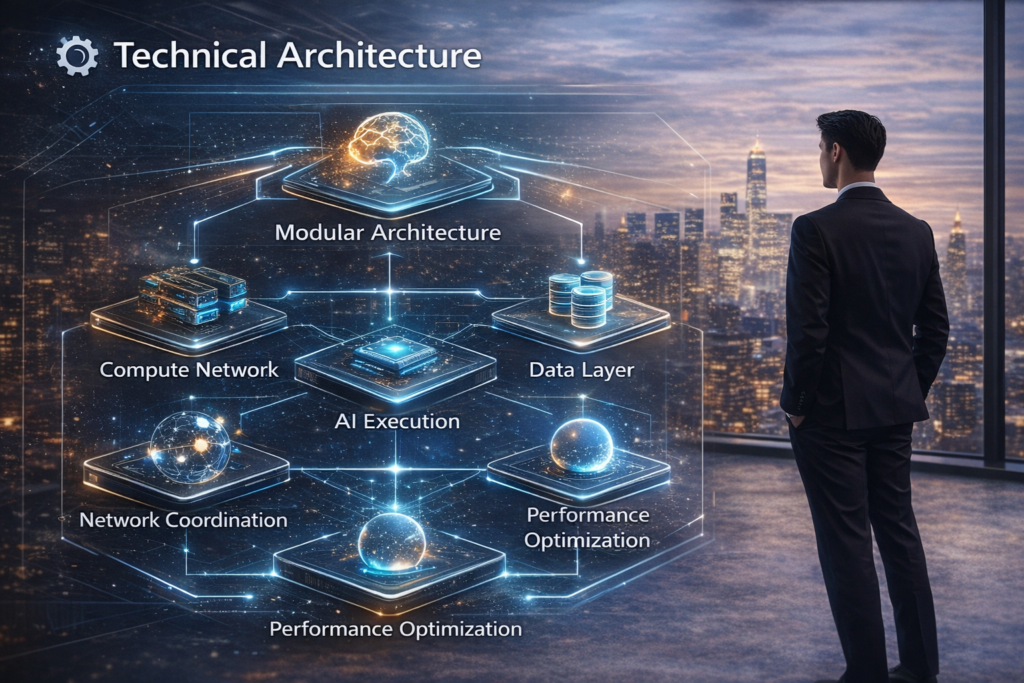
The AIDC technical architecture is designed to support scalable and efficient artificial intelligence operations. It connects computing resources, data layers, and intelligent systems through a structured and distributed framework.
As a result, the network enables more reliable performance while maintaining flexibility across different use cases.
🧠 Modular System Design
AIDC adopts a modular architecture. Each layer operates independently, yet remains fully integrated with the overall system.
This approach improves system stability. In addition, it allows new components to be added without disrupting existing operations.
Because of this, the platform can evolve continuously as technology advances.
⚡ Distributed Compute Infrastructure
The compute layer is built on a distributed network of GPU resources. It allows workloads to be executed across multiple nodes.
Through intelligent scheduling, tasks are assigned dynamically. As a result, resource utilization is improved and latency is reduced.
Furthermore, the system supports scalable expansion. New compute nodes can be integrated without affecting performance.
🔗 Data Coordination Layer
Data is managed through a structured coordination layer. This layer ensures that datasets can be accessed, shared, and utilized efficiently.
At the same time, control and integrity are maintained. This supports secure interaction between participants.
As a result, the system enables better data availability for AI training and inference.
🤖 AI Model Execution Layer
The model layer handles deployment and execution of AI models. Developers can publish models and make them accessible across the network.
In addition, the system supports usage-based interaction. This allows models to generate continuous value over time.
Because of this, the architecture encourages ongoing innovation and participation.
🌐 Network Coordination Mechanism
AIDC integrates coordination mechanisms across all layers. These mechanisms manage resource allocation, task distribution, and system optimization.
As a result, the network operates more efficiently. It can also adapt to changing workloads and demand conditions.
🔮 Performance Optimization
To enhance system performance, AIDC applies multiple optimization strategies.
These include intelligent scheduling, adaptive resource allocation, and continuous system refinement.
In addition, performance is monitored and adjusted in real time. This ensures stable operation under varying workloads.
🚀 Scalable and Adaptive Framework
The overall architecture is designed for long-term scalability.
New technologies, new participants, and new use cases can be integrated smoothly. As a result, AIDC supports continuous growth within the AI ecosystem.

⚙️ System Architecture
AIDC adopts a multi-layer architecture designed to support the full lifecycle of artificial intelligence operations. Each layer is structured to operate independently while remaining fully integrated within a unified system.
At the compute layer, distributed GPU nodes provide scalable processing power for AI workloads. The data layer manages storage and access, ensuring efficient data availability across the network. Above this, the AI layer enables model training and inference through optimized execution engines.
In addition, the blockchain layer supports transaction processing and value settlement, while the application layer provides access to AI services through a unified marketplace interface.
As a result, AIDC forms a complete and scalable infrastructure that connects compute, data, and intelligent applications into a single coordinated system.
🔒 Security and Optimization
AIDC integrates advanced technologies to ensure data security and system reliability across the network.
To protect sensitive information, the system applies zero-knowledge proofs, multi-party computation, and encrypted storage mechanisms. In addition, access control frameworks ensure that data usage remains secure and compliant.
At the same time, AIDC addresses key challenges within the AI ecosystem. For example, uneven distribution of computing resources is improved through dynamic scheduling algorithms. Data privacy concerns are mitigated through encrypted computation techniques, while high training costs are reduced by leveraging shared compute networks.
Because of this, AIDC creates a more balanced, secure, and efficient environment for AI development and deployment.
Scalable AI Infrastructure Design
AIDC connects compute, data, and intelligent systems through a multi-layer architecture designed for efficiency, scalability, and secure collaboration.
Compute Layer
Distributed GPU Nodes
Data Layer
Storage & Access System
AI Layer
Training & Inference
Blockchain
Settlement System
Application
AI Marketplace
Security & Privacy
- Zero-Knowledge Proof
- Multi-Party Computation
- Encrypted Storage
- Access Control System
Challenges & Solutions
- Uneven Compute → Dynamic Scheduling
- Data Privacy → Encrypted Computing
- High Cost → Shared Compute Network